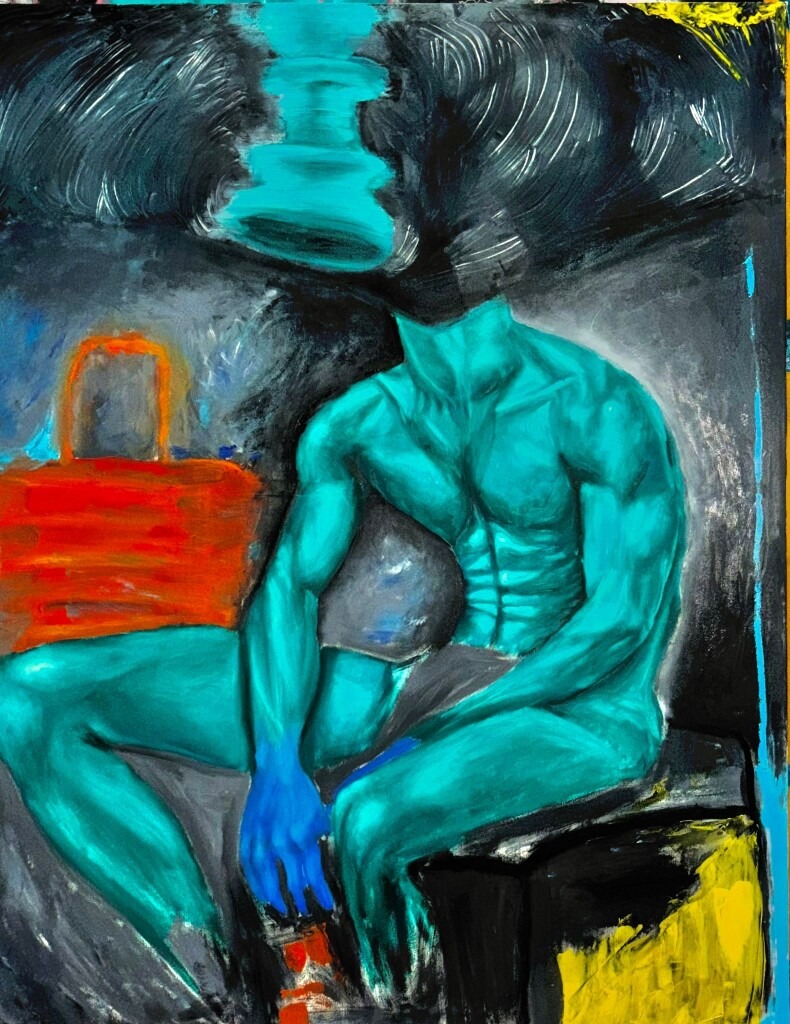
According to Getlein (1998), to understand a work of art, two steps are very important. The first is to consider the work’s form, and the second is to investigate its iconography. It is, therefore, instructive to enunciate one of Bemi‘s recent works from these two frames. “Castled Consciousness” is a life-size painting composition of a seated naked male figure that is seemingly headless.
Green hues dominate the painting, while the environment is characterised by dark, undefined spaces. Generally, the musculature of the figure is precise, pectoral striations insinuated, while a ladder of abdominal plates is provided, yet where the head should conclude the anatomy, a turbulent teal vortex rises instead, as though the person’s thought has liquefied and ascended, leaving the body to brood. It is a picture suspended between the naturalism of a figure study and the unnaturalism of a metaphysical proposition.
Interestingly, because Bemi denies us a face, the figure cannot be anyone in particular; it becomes, to use Hegel’s word, that so delighted Warhol, Geist or spirit. The body is emphatically there, but consciousness is elsewhere, spilled upward into painterly weather.
Prof. Duniya Giles Gambo, reviewer, Castled Consciousness
The result is an ontological glitch consistent with post-human anxieties: muscles without mind, presence without identity. In the terms of Arthur Danto (1924–2013), the renowned philosopher of art, history, and action, art proposes an “aboutness” that no mere bodily description can exhaust. The painting is about the forfeiture of self, the liquidity of the modern subject and the way information technologies relocate personhood from flesh to cloud.
Formally, Bemi oscillates between two registers of anatomy and colours. The anatomy is modelled with almost academic fidelity; however, the figure’s right hand appears stylised. Could this be a deliberate attempt to break the almost realistic anatomy? The figure is surrounded by what can be referred to as zones of colours that behave like philosophical clauses. A scumbled vermilion block on the left evokes both a satchel and a warning beacon. A slash of yellow, at the lower right, behaves like a syntactical flourish, sign-posting the limits of the seated platform, while simultaneously insinuating the autonomy of colour.
Danto (1964) argued that, after Warhol, anything could be a work of art, provided the art world could construe it in terms of meaning. Bemi’s canvas places itself squarely inside that discursive arena. One can read it as an allegory of masculine stoicism or an Adonis, immobilised by burdens not shown. One can also readily read it as a critique of capitalism’s demand for perfect bodies yoked to disembodied labour. The orange bag might be the day’s emotional freight; the jagged teal plume might be data escaping the skull. The painting is generous to interpretation, not because it is vague but because it knows, like Borges’ “Garden of Forking Paths,” that significance is plural.
This is not, however, an illustration of a theory; it is a work staging the very conditions under which a theory becomes practical. The brush swirls that halo the absent head recall the vortex in Leonardo’s Deluge drawings and the spiritual cyclone in Bacon’s “Figure with Meat.” Yet Bemi’s turbulence is digitally blue; it looks less like weather than like a corrupted file preview. Thus, the painting fuses painterly memory with the contemporary screen, affirming the conviction that history never ends so much as accumulates in layered quotation. What of beauty? One would maintain that beauty after modernism was optional, but when it appeared, it had to justify itself philosophically.
Bemi’s figure is radiant, almost seductive, but its seduction is interrupted by passages of sooty black and industrial grey. The painting grants pleasure, then interrupts it, making beauty provisional, which is another contingent aesthetic value. Her work is a reflective reminder that an artwork is an embodied meaning and hence, a metaphor turned flesh. Thus, she has literalised that aphorism, such that it seems to be rising into the atmosphere of thought. It proposes a twenty-first-century intimate self-portrait in which the face has symbolic significance. However, on closer observation, the figure’s body erupting an indeterminate vortex forms a castellated silhouette. All of these illustrate the painting’s conceptual edge.
The absence of a human head is thus not only a loss of identity, but a substitution, where the mind is replaced by a calculated manoeuvre, fuelled by tactical inspiration. What appeared to be a liquefied head might equally be a cacophony of stacked decisions, an algorithmic self. Hence, Bemi, knowingly or not, constructs bodily presence into the semiotics of contest and control, underscoring the contemporariness of subjecthood, which is often played out on grids, digital, economic, and geopolitical platforms, where every move is surveyed and determined.
This reminds us that the most fertile paintings are those that keep disclosing new layers of “aboutness” each time we look, just as most critics believed art’s philosophical dimension is an endless game of interpretive chess. In the end, the canvas appears mute, yet eloquent. Scholars of past centuries would have smiled at that paradox, and then translated it into art history’s continuous presence, where Bemi’s “Castled Consciousness” of a headless blue man, now takes his seat. For this artist, the burgeoning passion for painting has been transformed into a solitary pursuit of a dynamic career. Bemi’s artistic odyssey has been meteoric. She constantly reminds us of the power of human potential, demonstrating that artistic brilliance can flourish, even in the most unexpected of fields.
This review was written by Prof. Duniya Gambo. A leading scholar of art history and visual culture, Prof. Gambo serves as the intellectual helm of Abuja Art Review. Based at Ahmadu Bello University, Zaria, his academic contributions have significantly advanced understanding of Nigerian art traditions, critical theory, and museology. His editorship ensures scholarly rigour and thematic coherence across the publication’s engagements.